

How to Make Hot Pepper Jelly – Gifts From the Kitchen
Homemade hot pepper jelly is one of my favourite gifts from the kitchen. Hot pepper jelly is sweet, spicy, and one of the easiest jellies you can make at home. It uses sweet peppers, hot peppers, dried apricots and liquid pectin. It takes less than 30 minutes to prep and 10 minutes to process to make 12 small jars, perfect for gift giving.
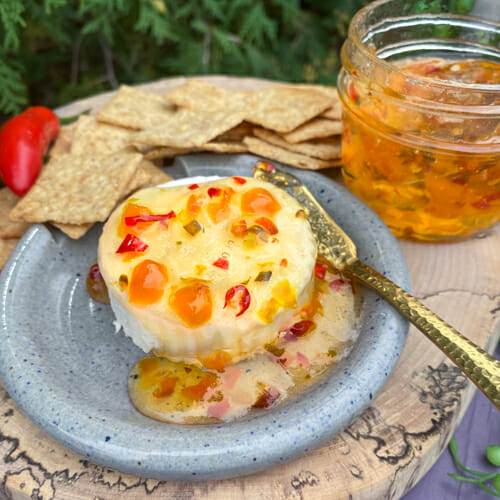
This isn’t your typical breakfast jam. Hot pepper jelly pairs better with crackers and cheese than with toast. Spoon it over cream cheese, brie, Camembert, smoked cheddar or chevre for an easy appetizer, or use it as a glaze for meat and roasted vegetables.

Read more: Roasted Carrots with Pepper Jelly, Flavourful Wraps made with Leftovers, Hot Pepper Sauce, Homemade Hot Pepper Flakes
How to Use Hot Pepper Jelly
Here are some ideas to get you started. I bet you can think of even more ways to use up your jelly, don’t limit yourself!
- Use as an appetizer with cheese and crackers (use cream cheese, goat cheese, brie, etc).
- Serve with chicken, turkey, pork or duck.
- Use as a spread on ham, turkey or left over roast meat sandwiches.
- Use as a glaze when making a roast.
- Use as a glaze for roasted vegetables (see carrots).
- Mix into ground meat when making hamburgers or meatballs.
- Use it in dressings or marinades to add a little heat.
- Use in sweet and sour sauces.

Why Do Peppers Float in Pepper Jelly?
Peppers and apricots have tiny pockets of air trapped inside them. While the jelly is hot and runny, those light pieces rise to the top before the jelly has a chance to set. Floating doesn’t make your jelly unsafe. It just means the pretty pieces end up at the top instead of spread through the jar.
Here’s how to keep them suspended:
- Chop small and even. Tiny, uniform pieces float less and look more decorative.
- Follow the boil time exactly. Jelly that’s undercooked sets slowly, which gives the pieces more time to rise.
- Rest and stir before filling. Take the pot off the heat and stir gently every minute or so for about 5 -7 minutes. The jelly thickens slightly and holds the pieces better. It should still be very hot when you fill the hot jars.
- Swirl jars gently after processing. Once you have heat processed the jars, leave them in the canner for 5 minutes. Then remove them from canner and leave on counter for 2-3 minutes. Once the lids form a seal, gently swirl the jars to disperse the peppers.
- Let jars cool undisturbed. Leave them for 12 to 24 hours before checking the seals.
- If pieces float anyway, just stir the jelly when you open the jar.

How to Make Pepper Jelly Milder or Hotter
Peppers are a low-acid food, so the total amount of peppers in this recipe needs to stay the same for the jelly to be safe on the shelf. You can still control the heat. Just change which peppers you use, not how many.
To make it milder:
- Use a milder hot pepper, like jalapeño.
- Use more sweet peppers and fewer hot peppers, keeping the total amount the same.
- Remove the white ribs and seeds from the hot peppers. That’s where most of the heat is.
To make it hotter:
- Use a hotter pepper. From mild to hot: jalapeño, serrano, cayenne, habanero.
- Use more hot peppers and fewer sweet peppers, keeping the total amount the same.
- Leave in the white ribs and some seeds.
Pro Tip: Wear gloves when handling hot peppers, and don’t touch your eyes or face.
Do You Have to Process Pepper Jelly in a Hot Water Bath?
If you want to store your jelly on the shelf, yes. The boiling water bath heats the jars enough to destroy moulds and yeasts, and it creates a strong seal. Please don’t skip it, especially if you’re giving jars as gifts.
Old methods like flipping hot jars upside down or sealing with wax are no longer recommended. Flipped jars may seal, but the seal tends to be weaker than one from a water bath, and wax can crack and let mould in.
If you don’t want to do a water bath, you can keep the jelly in the fridge for several months or freeze them as shown below.
Can You Freeze Hot Pepper Jelly?
Yes, you can freeze hot pepper jelly. Freezing is a great option if you want to preserve its flavour for an extended period without worrying about canning. Here’s how:
- Cool the Jelly Completely: Make sure the jelly is fully cooled before freezing to avoid excess moisture or condensation.
- Use Freezer-Safe Containers: Pour the jelly into airtight, freezer-safe containers, leaving about half an inch of headspace to allow for expansion. You can even use jam jars, just remember to leave 1/2 inch of space at the top.
- Label and Freeze: Label the containers with the date and freeze. The jelly can last up to a year in the freezer without losing its texture or flavor.
- Thawing: When you’re ready to use it, thaw the jelly in the fridge overnight. Once thawed, give it a good stir, as it may separate a bit.
Using Powdered Pectin for Hot Pepper Jelly
Liquid pectin is a little more forgiving when it comes to making jelly with high acid jellies like this one using vinegar. It’s easy to incorporate and results are fairly consistent. But it’s more expensive and can be hard to find at times.
You can make this jelly using powdered pectin but there are some important differences.
- Add powder pectin at the beginning of cooking.
- Stir VERY WELL as powder pectin has a tendency to clump. Consider mixing a tablespoon of the sugar with the pectin before adding to pot.
- Powder pectin is more precise – don’t mess with the fruit to sugar to acid ratio.
Here are the steps:
- Add sweet peppers, hot peppers, apricots, and vinegar to large stainless steel pot.
- Add powdered pectin and stir very well until well distributed.
- Add sugar and stir until dissolved. Bring the mixture to a full rolling boil over high heat, stirring constantly. Boil hard for 1-2 minutes, ensuring a strong, rapid boil to activate the pectin.
- Remove from heat and let the mixture rest for 3-5 minutes, stirring occasionally to help evenly distribute the peppers and apricots.
More Savoury Jams & Jellies
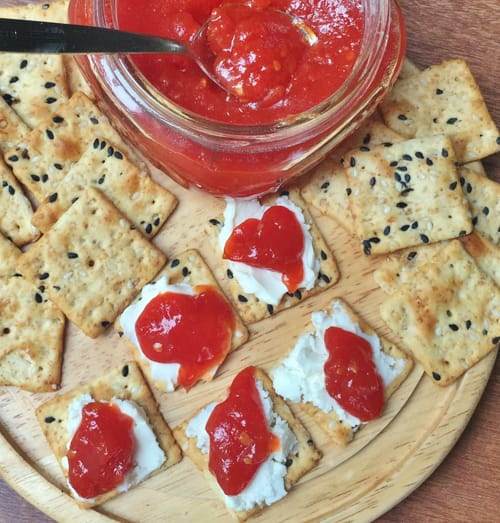
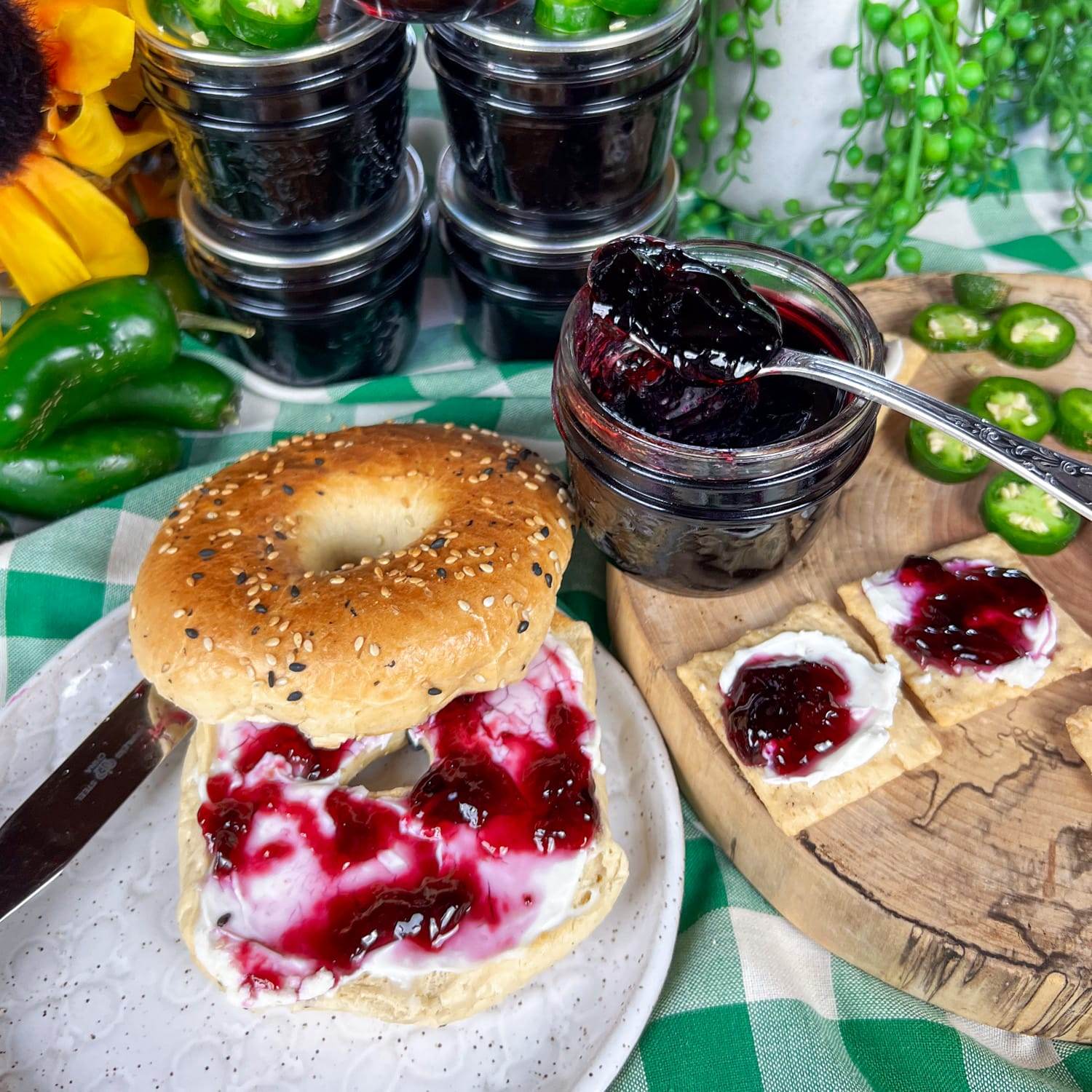
If you like sweet and savory jellies, you may also want to check out this Tomato Jam and Jalapeno Grape Jelly.
Recipe for Hot Pepper Jelly
Hot Pepper Jelly – Sweet Spicy Gift From the Kitchen
Ingredients
- 1 1/2 cups sweet peppers finely chopped blend of yellow, red and orange
- 1/2 cup dried apricots finely diced
- 3/4 cup jalapenos (or other hot peppers) 6-8
- 1 1/2 cups white wine vinegar
- 6 1/2 cups sugar
- 1 pouch liquid pectin Certo brand
- No liquid pectin? Powder Pectin Substitute
Instructions
- Dice sweet peppers and apricots finely and evenly. Smaller pieces will look more decorative and will be less likely to float to surface of jar.
- Cut hot peppers into very small pieces. Keep some white pith and seeds for added heat. Use a combination of different hot peppers if you wish.
- Combine peppers, apricots, vinegar and sugar in stainless steel (not aluminum) pot.
- Bring to full boil. Stirring constantly, boil hard for 1 minute.
- Remove from heat. Stir in liquid pectin. ** Read instruction for your package of pectin – they vary – even within same brand. **
- Stir and skim for 5-7 minutes. This helps keep peppers evenly distribute in jelly.
Hot Water Bath Canning
- Pour into hot jars leaving a ¼ inch (6 mm) headspace.
- Wipe rim with clean cloth and seal with sealing lid.
- Screw band on top and tighten finger tight.
- Process in hot water bath for 10 minutes.
- Remove jars. Cool undisturbed for 24 hours and check seal.
- Best used within a year, but as long as the seal is tight, it will be safe.
Freezing
- Fill freezer containers or glass jars leaving minimum of 1/2 inch space.
- Let cool completely before sealing and transferring to freezer.
- To thaw place in fridge overnight and stir well as it may seep or separate slightly.
Notes
Nutrition Facts (per serving)
Canning at Higher Elevations
Water boils at a lower temperature the higher up you live, so jars need more time in the water bath to heat through safely. The processing time in this recipe is for elevations up to 1,000 feet (305 metres). If you live higher, add time as shown below.
| Elevation (feet) | Elevation (metres) | Add to processing time |
|---|---|---|
| 0 to 1,000 | 0 to 305 | No change |
| 1,001 to 3,000 | 306 to 915 | Add 5 minutes |
| 3,001 to 6,000 | 916 to 1,830 | Add 10 minutes |
| 6,001 to 8,000 | 1,831 to 2,440 | Add 15 minutes |
| 8,001 to 10,000 | 2,441 to 3,050 | Add 20 minutes |
Not sure of your elevation? Search your town’s name plus “elevation.”
Looking for more delicious gift ideas?
Grab your FREE copy
Download this ad free printable Guide and learn to make beautiful, delicious Gifts from your Kitchen.
Includes tips & links to 50+ ideas for homemade, shelf stable gift giving.
- Cookies in a Jar
- Soup in a Jar
- Flavoured Infusions + Preserves
BONUS printable gift tags
Cook with the seasons, effortlessly! I’m Getty, a food educator and Professional Home Economist, helping you select, store, and serve seasonal ingredients in delicious, simple, everyday meals. Sign up for seasonal tips and recipes delivered straight to your inbox, and dive deeper with my books, guides, or YouTube content.
Can this recipe be multiplied and if so, how big of a batch do you think would still set.
Also, I use powder pectin, do you know the conversion to powder from liquid? Thank you.
The official recommendation is not to multiply jam or jelly recipes. The pectin needs to reach a certain temp within a certain time frame – if you increase the volume the timing will be off and the pectin may not set the way you want it to. Also, keeping everything hot while you’re filling jars and fitting all the jars in the hot water bath will be an issue. So it’s best to do one batch at a time and I definitely wouldn’t do more than double the batch.
Here’s info on substituting for liquid pectin – I would definitely try a single batch first if you’re making this substitution. https://www.gettystewart.com/substitute-for-liquid-pectin/
I just updated this recipe to make a bigger batch. I also added a section on how to use powdered pectin. Now that Bernardin is no longer making pectin, it’s more challenging to find liquid pectin.
I made this recipe yesterday and found that it set up very stiff. It was very difficult to spread on the goat cheese topped on a cracker. I just read online that when using ‘liquid’ pectin it should be added after the first ingredients boil for one minute. Then it said that you take the jelly with the added pectin off the heat and ‘not bring to a boil again’ which is explained to do in this recipe. I wonder if that is why the jelly is the consistency it is. I would not chose to make this recipe again because of this. Any thoughts?
Hi Nancy,
It’s hard to know why your jelly set up so firmly, I have never had that happen to me and I use this recipe in many workshops. I have made the mistake of using expired pectin and having very runny jelly – totally my mistake!
Liquid, powdered, low sugar, no sugar pectins all work slightly differently and have different cooking methods and requirements. For example, as you discovered liquid pectin is typically added toward the end of the cooking process while powdered pectin is used at the beginning. It is important to follow jam making instructions carefully and always use the type of pectin specified in a recipe in order to get the results you want.
My family loves this recipe, I hope you’ll give it another try some time.
All the best,
Getty
Thanks for your reply. I believe I followed your recipe closely but was unsuccessful although flavour there. Only when I plan on ‘gifting’ does this happen. Go figure:)
Yes, that’s exactly when things go wonky! No idea what could have caused your jelly to be extra stiff.
It may be a difference in pectin brands, they can vary. The recipe was based on Bernardin pectin, but Certo pectin sets up differently. I’ve made some changes to the recipe to reflect some of these differences, especially now that Bernardin pectin is no longer available.
Love it! Tastes so good and the recipe worked perfectly.
Thanks for the feedback Brian. Glad you’re enjoying it!
Is it possible to freeze this little wonder?
Thanks in advance
Louise
I’ve never tried freezing this jelly before so I’m not sure how it will hold up. There are no safety reasons why you shouldn’t be able to freeze this jelly, it’s just a matter of whether or not the texture and color will stay true. I suspect it should be fine.
Are you asking because you prefer to avoid the hot water bath? If so, let me just say the hot water bath is super easy, even if you’ve never done it before or you don’t have a canner. You do need proper canning jars though – I recommend the wee little ones so you don’t have to worry about finishing a whole jar at once. Simply line a big soup pot with a dish cloth, place sealed jars in pot, cover with 1 inch of water and boil for 10 minutes. That’s it! Then they’ll be safe on the shelf for at least a year.
Yes! I’ve included instructions in the article. It may weep a little after thawing, but mixing it well should fix that. Enjoy