

How to Stop Onion Tears (Plus How to Remove Onion Smells)
If chopping onions feels like an emotional experience… you’re not alone.
Some onions barely bother us. Others have us reaching for tissues before dinner even starts.
If you want to know how to stop onion tears, I’ve done the homework for you. After soliciting your advice, researching and testing out different methods in my kitchen, I discovered there are 5 key strategies with16 different ways to implement them in your kitchen. I also have simple ways to remove onion smells from your hands and kitchen.
Want to see what I do to stop onion tears? Go Here.
Quick Summary: Best Ways to Stop Onion Tears!
- Chill out: Pop onions in the freezer for 10 minutes before starting.
- Stay Sharp: Use your sharpest knife to prevent crushing onion cells.
- Save the Root: Leave the hairy root end attached until the very end to keep the gases contained.

Why Do Onions Make You Cry?
When you cut into an onion, you break open its cells. This releases a sulfur-based gas that rises into the air and reaches your eyes.
The gas reacts with the moisture on your eyes and creates a mild acid. That reaction causes the stinging sensation and makes your eyes water.
Your body isn’t being dramatic – it’s protecting you. Tears form to wash the irritant away.
Some onions trigger stronger reactions than others. Fresh onions and certain varieties tend to release more of the compounds that cause irritation.
The fresher the onions, the more likely they are to cause tears.
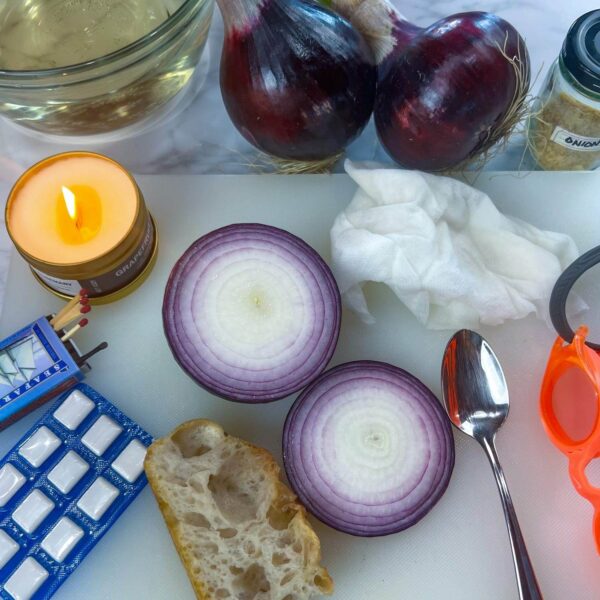
5 Strategies & 16 Tips for Reducing Onion Tears
Here are all the different techniques I tried. Some worked better than others. What I discovered is that they fit into 5 categories. Have a look and try out a few for yourself.
1. Block the Burn
These tips focus on creating a barrier between your eyes and the onion’s sulfur compounds.
- Wear swim or ski goggles or special onion goggles: Goggles create a barrier and prevent the onion’s sulfur compounds from reaching your eyes.
- Hold a metal spoon between your lips: Some people find that this helps redirect the onion’s vapours away from their eyes.
- Hold a piece of bread, cloth, or paper towel between your lips: Like the spoon method, this may help block or absorb some of the onion vapours before they reach your eyes.

2. Redirect the Vapours
These methods use airflow or heat to move the irritating compounds away from your face.
- Place a fan on your kitchen counter or cut underneath the oven exhaust fan: Air movement blows the volatile sulfur compounds away from your face.
- Light a candle beside your cutting board: The heat from the candle may draw the sulfur compounds toward it and away from your eyes.
3. Distract
Some tricks don’t stop the reaction itself, but they may reduce how much irritation you feel.
- Chew gum while chopping: Chewing gum encourages you to breathe through your mouth, which may reduce the amount of irritant that reaches your eyes.
- Light and extinguish a match and hold it between your lips: Some believe this helps neutralize a few of the onion’s compounds or simply distracts from the irritation.
4. Work Strategically
These tips focus on how you cut and handle the onion.
- Peel and halve all your onions, then chop quickly without leaning over your cutting board: Working fast and keeping your face away from the cutting area minimizes the time your eyes stay exposed to the irritating compounds.
- Use a chopper or food processor and open the lid away from you: This method contains the sulfur compounds inside the appliance and releases them away from your face when you open the lid.
- Use a really sharp knife: A sharp knife makes cleaner cuts, ruptures fewer onion cells, and releases fewer tear-inducing compounds.
- Leave the root end intact until the very end: The root end contains more of the tear-inducing enzymes. When you leave it intact while chopping the rest, fewer irritants enter the air.
5. Keep things Cool
Lower temperatures slow down enzyme activity and reduce the release of irritants.
- Place onions in the fridge for 30 minutes or 10 minutes in the freezer: Chilling the onion slows enzyme activity and reduces the amount of irritants released when you cut it.
- Peel onions under water, then make the first cut and hold under cold running water: Water washes away some of the sulfur compounds before they reach your eyes, and cold water further slows enzyme activity.
Bonus Strategy – Avoid the Issue
- Get your partner or kids to cut the onions. If you can get others to do this chore, you won’t cry anymore!
- Buy pre-chopped onions. You may cry at the price – but you won’t have to chop anymore onions!
- Use onion powder. It’s good, but you won’t get exactly the same flavour and of course the texture will be different – but no tears!
Have you tried of any of these? Let us know other tips that you’ve tried or that would make us smile through our onion tears.

My Personal Favourite
Let’s cut to the chase. Here’s my favourite method – a cool onion, a sharp knife and a quick chop. I’m all about strategy! Tell me your favourite way in the comments.
How to Reduce Smelly Hands and Cutting Boards
- Rub hands and cutting boards with a cut lemon or a mix of lemon and salt. Just watch out for chapped skin or minor cuts – yikes!
- You could also mask the smell by rubbing your hands with something that’ll smell a whole lot better – try coffee beans or fresh mint from the garden.
- Wear latex or latex-free gloves if doing a lot of cutting.
- My facebook friends have suggested rubbing with stainless steel bars (I’ve never tried this).
How to Reduce Onion Breath
- Chew on a sprig of parsley. That’s why it’s such a popular garnish!
- Suck on a slice of lemon.
- Gargle with 1/2 tsp apple cider vinegar mixed with a cup of water.


If you find a tip that works for you, let me know!
Delicious Onion Recipes





Cook with the seasons, effortlessly! I’m Getty, a food educator and Professional Home Economist, helping you select, store, and serve seasonal ingredients in delicious, simple, everyday meals. Sign up for seasonal tips and recipes delivered straight to your inbox, and dive deeper with my books, guides, or YouTube content.