

How to Make Rhubarb Fruit Leather (Oven or Dehydrator)
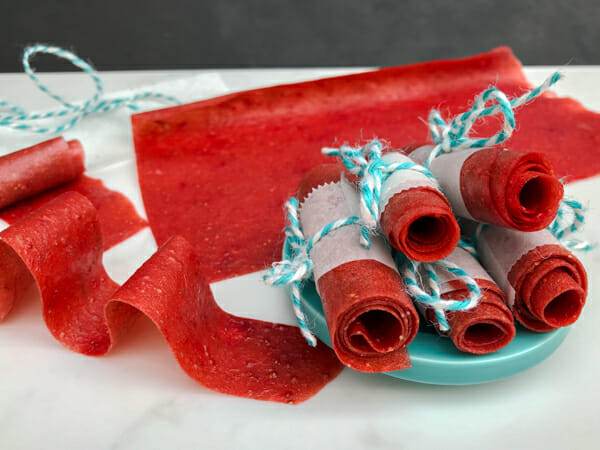
Learn to make rhubarb fruit leather. Whether using rhubarb fresh from the garden or using up last year’s frozen rhubarb, you’ll love this tasty treat.
Also Read: Cranberry Fruit Leather, Pumpkin Pie Fruit Leather, How to Tell if Fruit Leather is Ready
CAN YOU MAKE THIS FRUIT LEATHER IN THE OVEN?
Yes! I’m fortunate to have a dehydrator at home, so I like using it when making fruit leather, but you CAN make this fruit leather in the oven. Just be aware, it does take some time.
Here are the steps for making this fruit leather in the oven.
- Preheat the oven to 170°F (80°C). ( Avoid the air fryer setting as it may dry out the edges faster than the center.)
- Line a rimmed baking sheet with parchment paper.
- Prepare the puree to a thick spreadable consistency as outlined in the recipe below.
- Spread the puree on the parchment paper about 1/8 inch (1-2 mm) thin.
- Bake for 6 to 8 hours, or until no longer sticky to the touch, does not leave any indentations when pressed with fingers and separates easily from parchment paper.
- Remove from oven and let cool completely.
- Either remove from parchment paper or roll with the parchment paper (prevents the roll from sticking to itself)
- Use kitchen scissors or a sharp knife to cut into rolls. Enjoy.
How to Make Rhubarb Fruit Leather
Rhubarb Fruit Leather
Ingredients
- 2 cups rhubarb fresh or frozen
- 2 cups strawberries fresh or frozen
- 1/4-1/2 cup honey to taste
- 1 tsp vanilla extract
- 1 tsp cinnamon
- 1 cup applesauce
Instructions
- Combine rhubarb and strawberries in a pot with 1/4 cup water and cook until soft, 8–12 minutes. If using frozen fruit, you may need to simmer a few extra minutes after the fruit softens to evaporate excess liquid.
- Remove from heat, puree until smooth with blender and let cool.
- Combine with remainder of ingredients. Check the consistency of the puree. If it pours like a smoothie or spreads on its own when spooned onto the tray, return it to the pot and simmer a few minutes longer to evaporate excess liquid. The puree should be about the consistency of thick applesauce—thick enough to stay where you spoon it and require a spatula to spread evenly.
- Spread the puree evenly onto silicone-lined dehydrator tray (or parchment lined baking sheet for oven), about 1/8 up to 1/4 inch (3–6 mm) thick. Keep the layer as even as possible so it dries uniformly.
- Place in dehydrator and dry at 135°F (57°C) for 8-10 hours.
- Press leather with flat fingers, if there’s an indentation or any dark, wet spots, it’s not ready. If it comes off easily, it is done. Watch how to tell if Fruit Leather is Dry on YouTube.
- Roll and cut into strips. Let cool completely then store in sealed container for up to 1 month or in the freezer for longer.
- Makes 2-3 cups puree for an 8×6 inch to 8×8 inch sheet of leather
Oven Drying
- For oven drying: Line a baking sheet with parchment paper. Spread the puree evenly and rotate the pan as needed for even drying. If the edges dry before the centre, trim off the finished pieces and continue drying the remaining fruit leather until no sticky spots remain. Turn to 170° F (70°C). Dry for 6-8 hours. (see post for details)
Notes
Nutrition Facts (per serving)
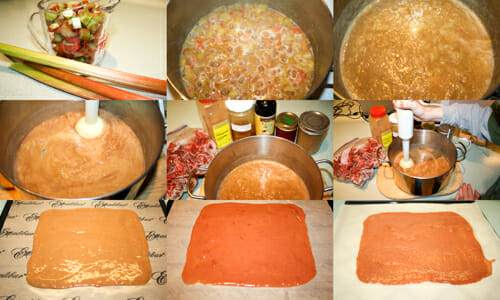
Here’s a photo collage of the process.
Rhubarb Fruit Leather Combinations
Yes, you can make fruit leather with just rhubarb, but it’s more fun when you add different flavors and textures.

We often mix in pureed frozen fruit like strawberries, mangoes, blueberries or raspberries. Added fruit really punches up the color!
Often, I will also add applesauce. I do this for two reasons. One, I often have buckets of homemade canned or frozen applesauce thanks to our apple trees so it’s a cheap way to double a recipe. Two, the pectin in applesauce helps thicken the puree so it stays nicely on the tray. This is a good trick for any fruit leather.
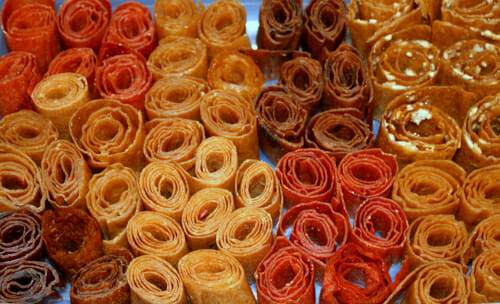
Sometimes, we also add nuts and seeds. It’s one of the ways I try to add more healthy fats and proteins to my snacking. This is especially important to me when I’m taking homemade fruit leather for extended backcountry trips. I like adding chia, hemp, slivered almonds, sunflower seeds.
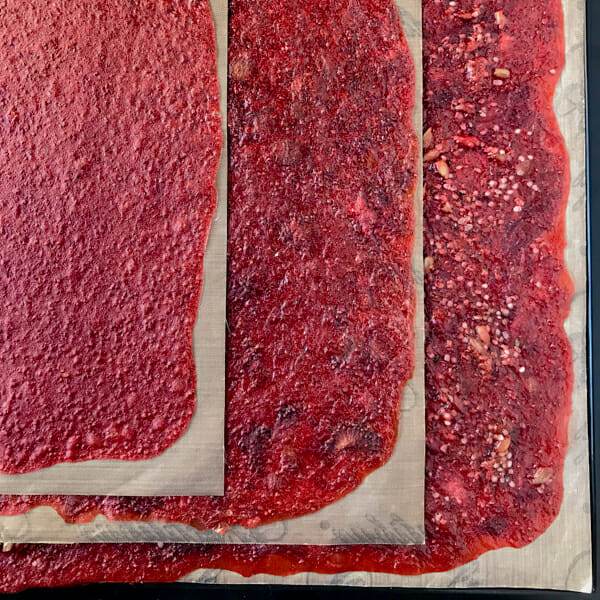
Also try different flavor makers and sweeteners like lemon zest, vanilla, cinnamon, pie spice, ginger, orange zest, orange juice concentrate, maple syrup, honey or your favorite jam.
When you make your puree taste it! Adjust the flavor and sweetness to suit your taste preferences. Drying will intensify the flavor, if you love it wet – you’ll love it even more dry!
Excellent Trail Food
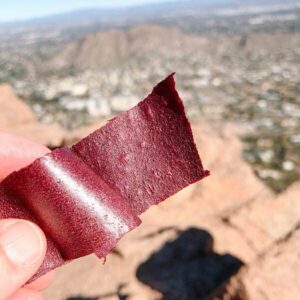
Fruit leather is a great trail snack, it’s the closest thing you might get to fresh fruit for a while! I use it two ways:
1. Eat as Is
Fruit rolls are perfect to chew on while covering some big miles. They’re light, easy to pack and a flavorful way to get a quick boost.
2. Re-hydrate in Dishes
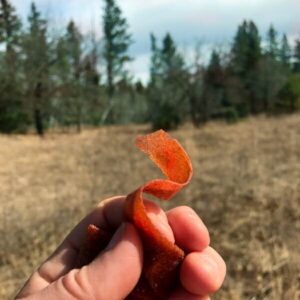
Pieces of dried fruit leather can also be added to other dishes like oatmeal or chia seed pudding. When you add the water to those dishes, the leather will re-hydrate and you’ll get fruity bits and flavor in your recipe.
Is Your Leather Dry or Too Dry
If you need a little more guidance on checking your fruit leather or if your fruit leather is too dry – it’s breaking into pieces, check out these articles.
How to Check for Dryness of Fruit Leather
What if My Fruit Leather is Too Dry
Other Fruit Leather Recipes
Pumpkin and Apple Pie Flavored Fruit Leather
I’d love to see your fruit leather creation. Leave a comment or take a photo and tag #getgettys so I can see it and like it!
Get all my best Dehydrated Recipes & Tips

Thank you, Getty, for your emailed response to my issue of the parchment paper adhering to the leather. I did place the sheet of leather on a damp tea towel and within about 10 minutes I was able to peel the parchment paper off the leather.
Hi Alison,
So glad it worked. Thanks for sharing your experience.
Help! I used parchment paper on an edged cookie sheet in the oven on “air fry” at 170 (lowest it will go). The parchment paper is embedded in the fruit leather. I made 2 trays (doubled your recipe). The front of the top tray is 3/4 dry to what seems like “just right”. The back 1/4 seems like it needs more time. Your video says to rotate the tray and put it back in. How do you keep the already done part keep from becoming over done? The bottom tray is crispy around the edges and what seems like probably “too dry” throughout. Parchment paper is hopelessly part of the leather on both trays. I’m trying your rehydrating method of placing the leather, parchment paper down, on a damp towel. It’s not in the oven, because the oven is still warm and I want to keep an eye on my disaster. Question: will the parchment paper ever separate from the leather or should I just cut my losses and toss both sheets in the trash now?
I’m a beginner as you may have gleaned from what I’ve said so far. The mixture may have been too liquidy due to using previously frozen strawberries that contained quite a bit more moisture than fresh strawberries would have. I also don’t have the experience to tell 1/8″ from 1/4″ thick layer of puree. You didn’t mention pouring off excess water after cooking the fruit to get it soft, so maybe it was too wet and that made the parchment paper soak into the puree? The paper and leather does have a wrinkled texture.
Ugh! I hate wasting food. But I guess it happens when you’re learning. Most recipes say they are easy or super easy, but are still challenging for this 70 year old beginner.
Thanks for any advice you can provide for salvaging all this rhubarb and effort.
Here’s an excerpt from the email I sent Alison to help with her dilemma. Sharing here in case it helps someone else.
Sorry for the difficulties you encountered making fruit leather and thanks for such a thoughtful description. It actually gives me some good clues about what happened.
My first thought is that you’re right and the puree was probably a little wetter than usual. Frozen strawberries often release much more liquid than fresh ones, and that extra moisture can allow the puree to soak into the parchment before it has a chance to dry. I also think the air-fry setting may have dried the edges much faster than the centre, which explains why one part became overdone while another was still wet.
If the parchment has actually become embedded in the fruit leather, as you described, it may not be possible to separate them. But before giving up, you could try laying the fruit leather fruit-side down on a clean sheet of parchment placed over a damp kitchen towel for 5–10 minutes. Add another damp paper towel on top. Hopefully the moisture will soften everything enough to help it release. Then you can try to salvage as much as you can. As a last resort, I might even try spraying a little water directly on the fruit to rehydrate it and make it soft so you can scrape some of it off. I would then use whatever I could salvage for a fruit sauce to put on ice cream or pancakes – well deserved after all that work! If you have a lot, freeze the sauce!
When you add nuts or seeds, do you just sprinkle them on the puree and press them into it before dehydrating? Grind them to make them finer? I’m getting ready to make some fruit leather to sustain my husband on a super-long multi-day bike race and want to include nuts, which work well as fuel for him on long rides.
I usually sprinkle them on and press them into the puree after I’ve put the puree on the dehydrator trays. I leave them in small pieces for the added texture. But you could grind them and add to the puree. I like variety in texture, on my leisure backcountry hikes – your husband may not care about texture and just want more protein – so fine grind mixed with the puree may be better for him. Good luck!
A friend has made leather recently and so I’m looking at what other recipes are out there. Always have a lot of the stuff and haven’t tried to dehydrate yet – so that is this year’s new thing. Have had successes with other fruit leathers and different combinations, as well as savoury creations. Don’t use the machine an awful lot, but it’s an amazing thing and I really should!
Hi Oratia,
The possibilities are endless – sweet or savory. I make savory leathers to use when camping or in soups or stews or sometimes as the soup or stew itself. If you have leftover tomato sauce or salsa, you can dehydrate that too.
Keep experimenting and putting that machine to good use!
Getty
What a great idea. I never thought of making fruit leather from rhubarb. I’ve only just dehydrated it and used it from there. I just picked my rhubarb, so it’s a perfect time to do it. Thanks for the tips
Hi Heather,
I’m glad you like this idea and are willing to give it a try. I sure hope you like it!
Getty
Thanks for including this article in your round-up!